 |
| Figure 1. This is a 10X magnification of a pedicel from a rose. Maybe if I'm fortunate enough, I will find a bacteria that looks just as beautiful! (Gracewood, 2010) |
Thursday, February 1, 2018
Larrea tridentata Research Project
The research I will conduct this semester involves identifying unknown bacteria from Larrea tridentata, also known as creosote bush. Various tests will be used to help determine and put a name on present bacteria. This is a continuance of last semester and because my previous DNA samples were lost, I will have to start over. It’s quite ok that this occurred because repeating procedures is great practice. I know for a fact this will benefit and enhance my skills in a research laboratory. In addition, I began working on my research proposal and will most likely have it posted next week. I cannot wait to begin my project and share my findings with you all!
Gracewood, P. (2010, August 9). Shadows On Stone. Retrieved February 01, 2018, from http://shadowsonstone.blogspot.com/2010/08/sculpture-and-eckhard-volcker.html

Thursday, January 25, 2018
New year, new opportunities!
I am so excited to be back at S-STEM because I genuinely enjoy myself there. The friendly atmosphere and the help I receive from my mentors allow me to feel at ease. Also, S-STEM has now merged with TRAIN and fortunately, I will have the chance to continue enhancing my research skills and knowledge at ASU West. With this in mind, I am happy and proud to say that I have been accepted to this school and will begin there Fall 2018! I am definitely looking forward to what the future holds. Aside from that, this will be my last semester at Phoenix College but I am eager to meet many of the new interns.
 |
| Figure 1. It's official, my Arizona State University acceptance letter! |
Thursday, December 7, 2017
Goodbye 2017, Hello 2018.
After a long, stressful and fun semester at S-STEM, it has officially come to an end. I must say, this research project was quite a ride. For instance, results disappointed me but somehow, when I had lost most of my hope, they surprised me. I also met new interns while also building relationships with previous friends. This semester was not that much different from the last because I was, and still am, happy. Everyone is so friendly and I am so grateful to have such an amazing opportunity. Since the year is ending, this week was dedicated to preparing for my presentation and finalizing my research paper. Hopefully I will be able to continue my research next semester but if not, I’ll have to see what’s in store! See you next year :P
 |
| Figure 1. Presenting the research project I conducted this semester in front of S-STEM interns and faculty. |
Thursday, November 30, 2017
Missing Bacterial DNA
Unfortunately, I found out about two weeks ago that the DNA I had extracted from my unknown bacteria was missing. I know I had not misplaced it or threw it away because I remember putting it back where it always goes. I had not mentioned it before because I thought that it would eventually turn up. However, that was not the case and I am quite upset about it because I am almost certain that it was not a mistake I made. With that said, there was no further advancement in my research project this week. Instead, I was preparing and creating a PowerPoint about my research, along with adding more information to my final paper. As far as I am concerned, I will present this PowerPoint in front of other STEM interns and Bioscience faculty. I guess I am going to have to find out for myself in a couple of weeks!
 |
| Figure 1. Possible PowerPoint theme for the research project that was carried during the Fall 2017 S-STEM internship. It will be titled "Identification of Bacteria Isolated From Wild and Urban Larrea Tridentata Utilizing RS-16 Sequencing". |
Thursday, November 16, 2017
Additional Unknown Bacteria
From last week’s broth, the resulting broth that was left at room temperature over the weekend is seen in Figure 1. In addition, this week, I grew Samantha Faltermeier’s unknown bacteria in TSB broth. The bacteria that I am working with has been isolated on a TSA plate from a creosote bush. As a side note, this bacteria is quite interesting because they all seem to be different. For instance, some have a horrible stench, while others don’t. Also, some almost look like snowflakes and some look like a typical round bacterial colony. As mentioned last week, I performed DNA extraction on these unknowns. Next week, if I am able to, PCR and electrophoresis are the next steps!
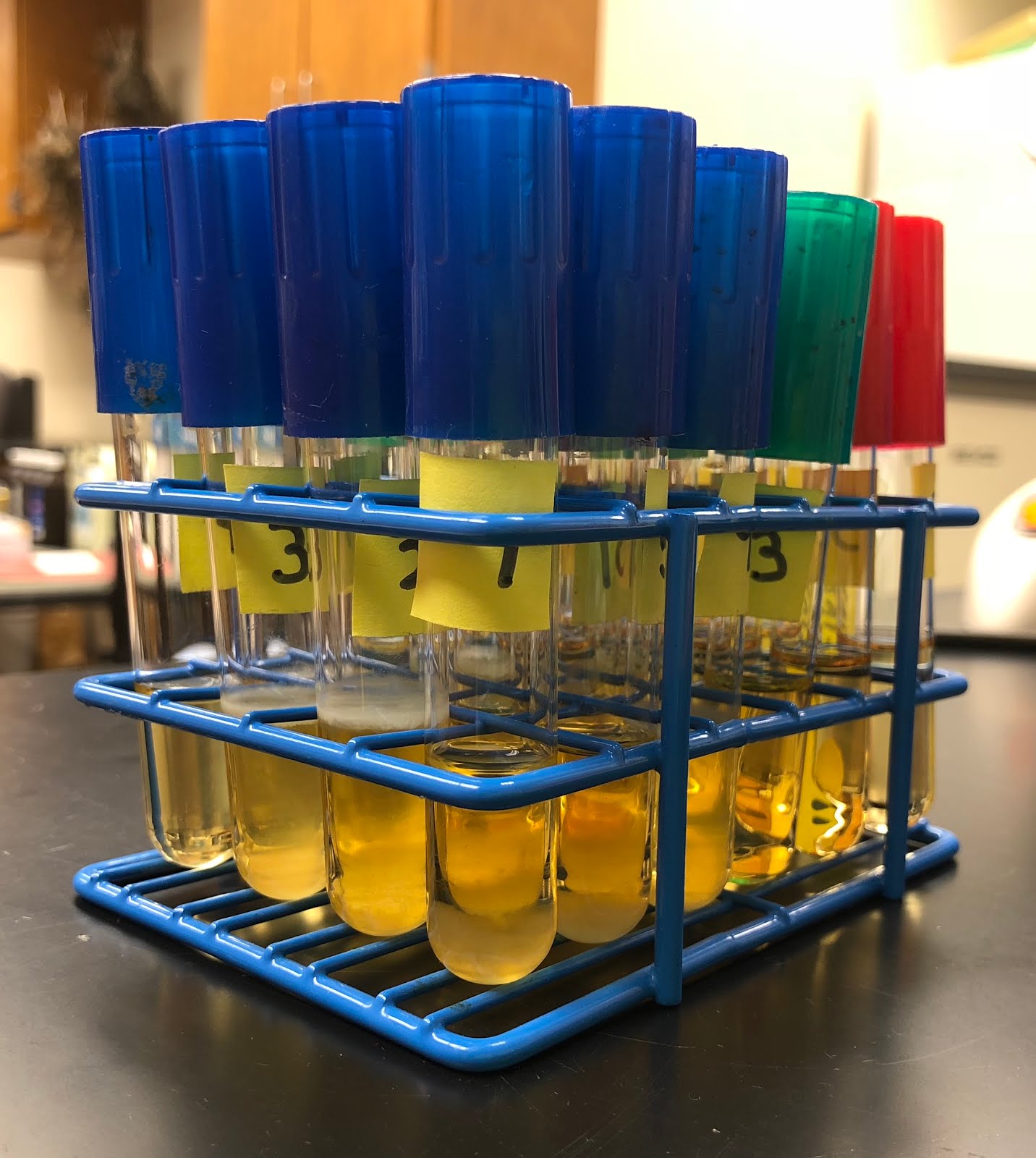 |
| Figure 1. The resulting TSB broth that was left at room temperature over the course of 5 days. These samples contained different unknown bacteria that was from a creosote bush. |
Thursday, November 9, 2017
Results... At Last!
On October 31, 2017, I ran my post-PCR DNA samples from October 26, 2017 under electrophoresis. Theses particular samples were different because I doubled everything, except the DNA. I added 20 microliters of Master Mix, 11 microliters of sterile water, 4 microliters of the forward primer, 4 microliters of the reverse primer and 1 microliter of DNA. All this totaled to an amount of 40 microliters. The primers used were 27F and 1492R. Once I ran these under electrophoresis, I finally got results (Figure 1)! I was so excited because at one point, I was beginning to think I was doing my procedures wrong. Nonetheless, I am happy to say that this change made a difference. Also, this week, I started growing bacteria in TSB broth (Figure 2) that was isolated by Samantha Faltermeier, an S-STEM intern. I will be performing DNA extraction and, eventually, PCR on these unknown bacteria!
 |
| Figure 1. The resulting gel after it was ran under electrophoresis. The post-PCR DNA in each row from left to right is as follows: MW Ruler, 1, 3, 4, 5, 6, 7, 8, 9, 10, 11, 12, 13 & E. Coli. The particular DNA that amplified were 4, 9, 10, 11, 12 & 13. These were the ones that showed bright bands. |
 |
| Figure 2. Unknown DNA samples from isolated bacteria in a Creosote bush. The samples were transferred from a TSA plate to these TSB broths. They are growing at room temperature and the samples are 1, 2, 3, 4, 5, 6, 7, 8, 9, 10, 11, 12, 13 & 14. |
Thursday, November 2, 2017
Project Background
What is currently known:
With the expansion of urban areas, figuring out what kind of bacteria grows on larrea tridentata is essential. This bacteria may or may not slowly kill a plant or seriously injure an animal or human. The same applies for wild larrea tridentata. However, there could be a possibility that the wild bacteria is beneficial to it and its surroundings. However, there is a chance that the certain bacteria is damaging to not only the plant but its environment as well. Figuring out which of the various species of bacteria are present will help lead to answer questions of interested. For instance, obtaining information about certain bacteria in urban and wild larrea tridentata can help explain why plant soil is toxic. An additional question of interest is whether there is a relationship between a species of bacteria and carbon monoxide. Could this potentially be one of the causes to the rise of carbon dioxide levels? Does the bacteria on these plants affect plants ability to obtain carbon dioxide? A study ran by L.P. Nguyen suggests that “the decrease in representation of Gram positives and the similar values for total bacterial DNA suggest that the representation of other bacterial taxa was promoted by elevated [CO2]” (Nguyen, 2011). Finding out whether or not carbon dioxide goes hand in hand with certain species of bacteria is valuable to know so that we can work together to reduce carbon dioxide levels and, thus, benefit living organisms (plants).
Currently, there are a wide range of research projects that have been conducted on larrea tridentata (creosote bush). In particular, a research carried by L.M. Nguyen and others, they were able to conclude that “the concentration of total bacteria 16S rDNA was similar in conditions of enriched and ambient [CO2]” (Nguyen, 2011). In other words, this particular DNA that is present in a creosote bush has a relationship with the amount of carbon dioxide. To support their findings, they noticed that “the decrease in representation of Gram positives and the similar values for total bacterial DNA suggest that the representation of other bacterial taxa was promoted by elevated [CO2]” (Nguyen, 2011). Another example involves an STD named herpes. Sandra Levy provided a the insight that there was a new product that was used to relieve symptoms. This product is Herp-Eeze, which “is a dietary supplement containing an extract of the plant Larrea tridentata” (Levy, 1999). In addition, it is also known that “arid ecosystems, which occupy about 20% of the earth's terrestrial surface area, have been predicted to be one of the most responsive ecosystem types to elevated atmospheric CO2 and associated global climate change” (Smith, 2000). Considering the fact the creosote bushes are located in a desert, this information does apply to it.
Importance to expand on this knowledge:
Importance to expand on this knowledge:
 |
| Larrea tridentata (creosote bush) ("Lady Bird Johnson Wildflower Center", n.d). |
References
Bell, J. (1989). The polymerase chain reaction. Immunology Today, 10(10), 351-355. Retrieved from ScienceDirect database.
Kuikman, P.J., & Van Veen, J.A. (1989). The impact of protozoa on the availability of bacterial nitrogen to plants. Biology and Fertility of Soils. https://doi.org/10.1007/BF00260510
Kembel, S. W., O’Connor, T. K., Arnold, H. K., Hubbell, S. P., Wright, S. J., & Green, J. L. (2012). Relationships between phyllosphere bacterial communities and plant functional traits in a neotropical forest. PNAS, 111(38), 13715-13720. https://doi: 10.1073/pnas.1216057111
Lady Bird Johnson Wildflower Center. (n.d.). Retrieved November 02, 2017, from https://www.wildflower.org/gallery/result.php?id_image=7711
Levy, S. (1999). Creosote bush in Arizona sprouts new herpes product. Drug Topics. Retrieved from General OneFile database.
Nguyen, L. M., Buttner, M. P., Cruz, P., Smith, S. D., & Robleto, E. A. (2011). Effects of elevated atmospheric CO2 on rhizosphere soil microbial communities in a Mojave Desert ecosystem. Journal of Arid Environments, 75(10), 917-925. Retrieved from Science Direct database.
Marques, J. M., da Silva, T. F., Vollu, R. E., Blank, A. F., Ding, G.-C., Seldin, L., & Smalla, K. (2014). Plant age and genotype affect the bacterial community composition in the tuber rhizosphere of field-grown sweet potato plants. FEMS Microbiology Ecology, 88(2), 424-435. https://doi.org/10.1111/1574-6941.12313
QuickExtract Bacterial DNA Extraction Kit. (n.d.). Retrieved from EpiBio website: http://www.epibio.com/docs/default-source/protocols/quickextract-bacterial-dna-extraction-kit.pdf?sfvrsn=8
Smith, S. D., Huxman, T. E., Zitzer, S. F., Charlet, T. N., Housman, D. C., Coleman, J. S., . . . Nowak, R. S. (2000). Elevated CO2 increases productivity and invasive species success in an arid ecosystem. Nature, 79-82. https://doi.org/10.1038/35040544
Stellwagen, N. C. (2009). Electrophoresis of DNA in agarose gels, polyacrylamide gels and in free solution. Electrophoresis, 30, S188-S195. https://doi.org/10.1002/elps.200900052
Steven, B., Gallegos-Graves, L. V., Yeager, C., Belnap, J., & Kuske, C. R. (2014). Common and distinguishing features of the bacterial and fungal communities in biological soil crusts and shrub root zone soils. Soil Biology and Biochemistry, 69, 302-312. Retrieved from ScienceDirect database.
Subscribe to:
Posts (Atom)